Over the past few decades, the textile industry has stood at a crossroads. On one side lies the convenience and low cost of synthetic dyes; on the other, the urgent need to address their environmental and health burdens. Textile dyeing is widely recognized as one of the major contributors to global water pollution, and yet synthetic dyes still dominate commercial practice. Natural dyes, despite their rich heritage, represent only a small share of the market and are often perceived as difficult to scale, inconsistent in shade, or less durable in performance.
The reasons for this imbalance are well known to both researchers and industry professionals: challenges in sustainable sourcing, cost, limited availability, and, crucially, issues of reproducibility and fastness. These very challenges, however, have sparked some of the most creative and impactful research in sustainable colorants. This book, focused on the valorization of tea waste as a fabric dye, is an excellent example of such innovation in action.
Tea is among the most widely consumed beverages worldwide, and tea processing generates large quantities of by-products and waste. While tea (Camellia sinensis) has been explored as a natural dye in academic studies, much of this work has remained at the laboratory scale, with limited translation to industrial application. The authors of this volume address precisely this gap. They demonstrate how waste fractions from Ready-to-Drink (RTD) tea manufacturing can be transformed into a robust, scalable, and commercially viable natural dyeing system.
One of the strengths of this book is its clear and logical structure. The opening chapters situate the work within a broader context, tracing the history and rise of synthetic dyes and outlining their impacts on human health and the environment. This is complemented by an accessible overview of contemporary textile dyeing technologies. Together, these chapters provide the reader with a solid foundation for understanding why alternative dyeing approaches are urgently needed.
The book then guides the reader from why to how. It presents a balanced discussion of natural versus synthetic dyes, outlining their respective advantages and limitations, and exploring the role of bio-based textile materials and green chemistry strategies in the fashion and textile sectors. This framing reinforces the idea that dye innovation cannot be isolated from wider efforts to build circular, low-impact textile systems.
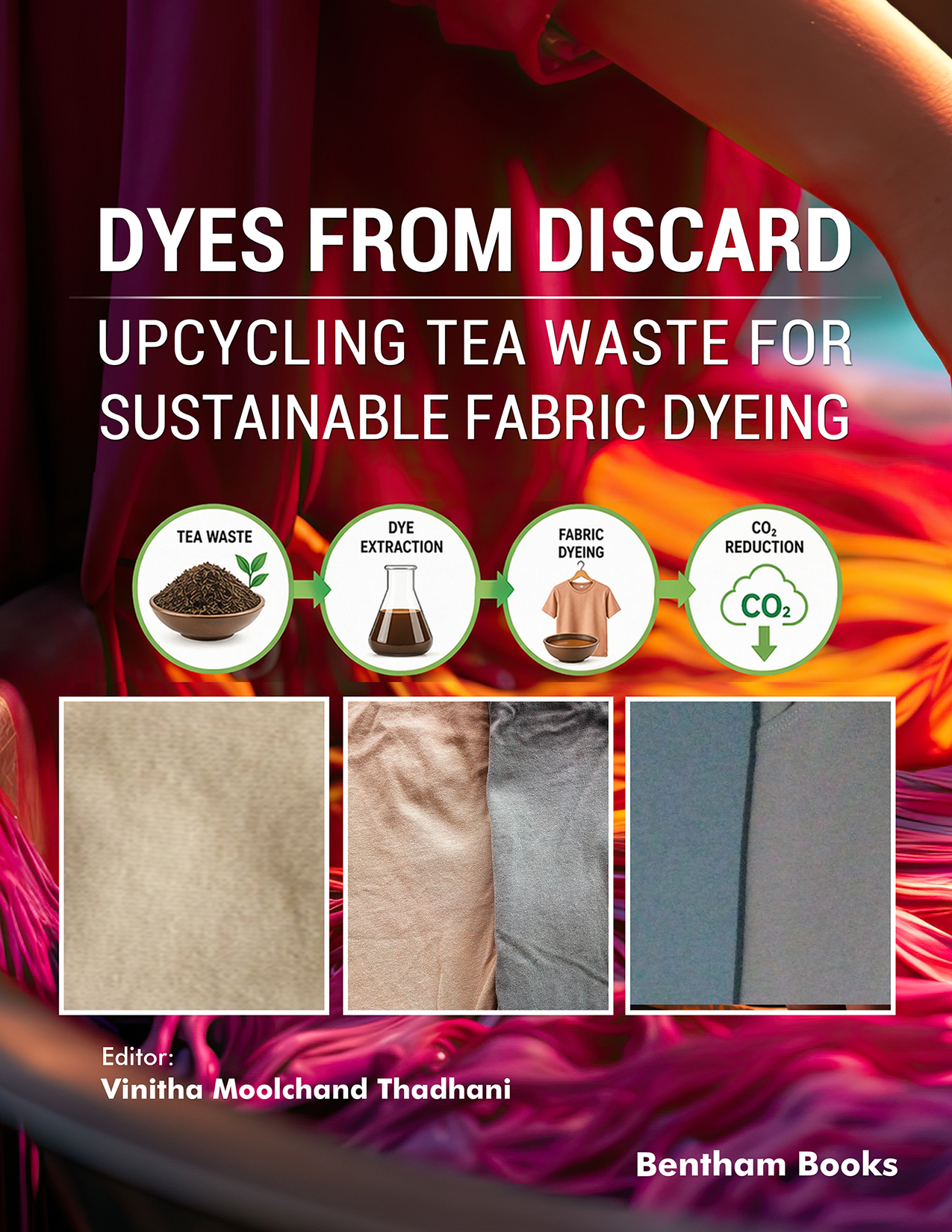
At the heart of the volume lies its central contribution: the use of tea waste for sustainable textile coloration. The authors describe in detail how black, oolong, white, and green tea waste streams can be converted into stable dye extracts, explaining the optimization of extraction conditions, application methods, and fastness properties. Importantly, the work does not stop at bench-scale experiments. The narrative follows the process from laboratory studies to pilot trials and then to bulk-scale implementation, offering a rare and valuable roadmap for practitioners interested in moving from concept to practice.
Equally compelling is the way this book embodies the principles of circular economy and industrial symbiosis. By viewing discarded tea fractions from RTD manufacturing as a resource rather than a waste, the authors demonstrate how one industry’s by-product can become another’s raw material. The fact that the approach has already attracted interest and implementation from reputed brands underscores both its technical soundness and its commercial relevance.
This volume will be of great interest to a wide audience. Researchers and students will appreciate its scientific rigor and clear explanation of process parameters. Textile and fashion professionals will find practical guidance on integrating natural dyes into existing production systems without compromising performance. Sustainability practitioners and circular economy specialists will recognize in this work a concrete example of how waste valorization can be successfully embedded in real industrial contexts.
Ultimately, this book is more than a technical guide; it is a testament to what can be achieved when thoughtful science, meticulous experimentation, and a genuine commitment to sustainability come together. By addressing long-standing barriers such as reproducibility, consistency, and scalability, the authors bring natural dyeing one step closer to mainstream industrial reality.
I am pleased to commend this book to readers and to support its contribution to the advancement of sustainable textile coloration and circular resource use.
Luqman Jameel Rather
College of Sericulture, Textile
and Biomass Science, Southwest University
Chongqing, China