
Editor: Vinitha Moolchand Thadhani

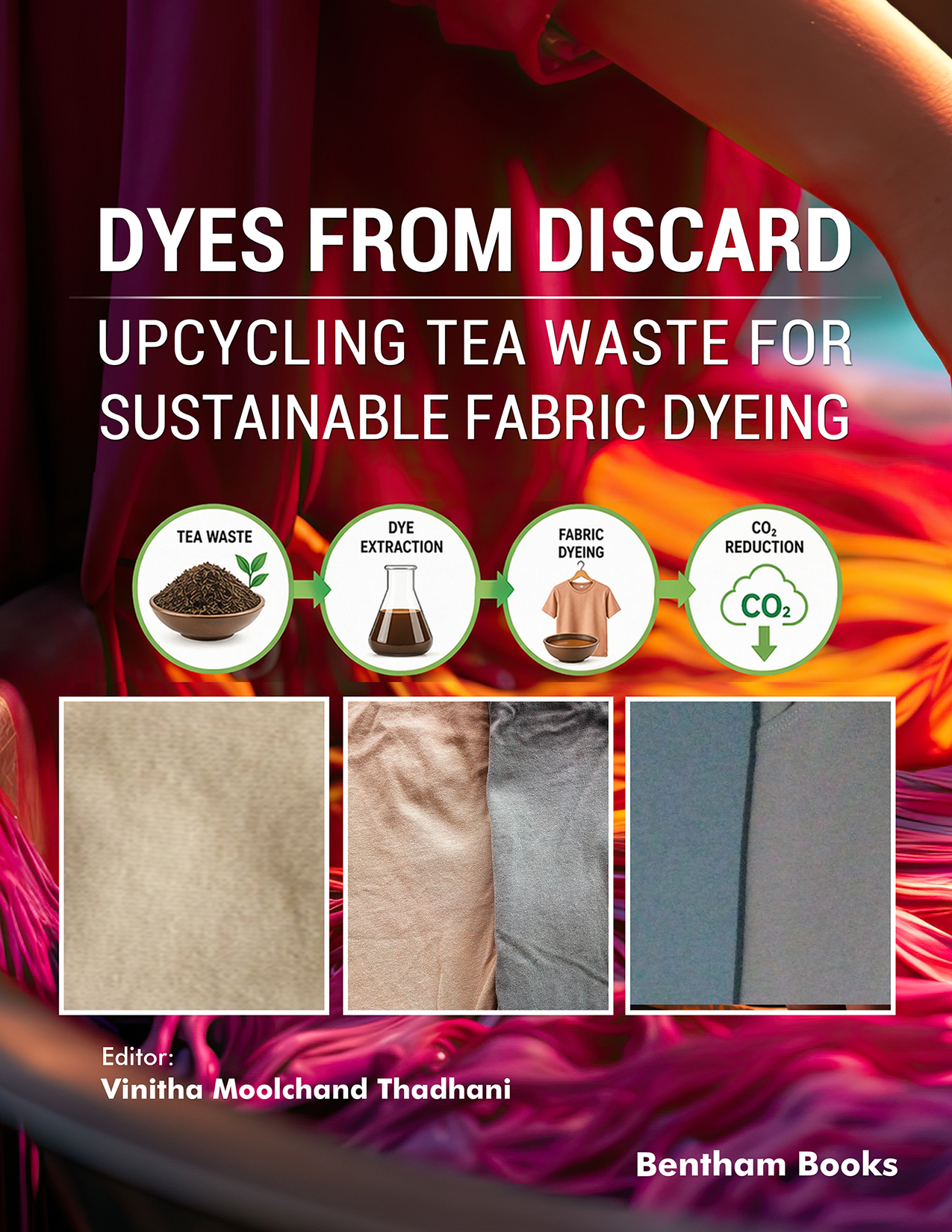
Dyes from Discard: Upcycling Tea Waste for Sustainable Fabric Dyeing

eBook: US $89 Special Offer (PDF + Printed Copy): US $143
Printed Copy: US $98
Library License: US $356
ISBN: 979-8-89881-541-7 (Print)
ISBN: 979-8-89881-540-0 (Online)
Year of Publication: 2026
DOI: 10.2174/97988988154001260101

Introduction

Dyes From Discard: Upcycling Tea Waste For Sustainable Fabric Dying promotes circular resource use in the textile industry by exploring sustainable textile colouration through the innovative use of tea waste. While natural dyes currently account for only 5% of the global market due to challenges like cost, availability, and reproducibility, this work demonstrates how these limitations have inspired impactful research and practical solutions.

The book begins by reviewing synthetic dyes, their environmental impact, and modern dyeing technologies, highlighting the need for sustainable alternatives. It then delves into natural dyes—their types, sources, advances, and challenges—and examines the role of bio-based textiles and green chemistry. The focus then shifts to practical applications, presenting detailed methods for extracting dyes from black, oolong, white, and green tea leaves and transforming tea waste into effective fabric dyes.

Finally, the book showcases a success story of scaling this innovation from laboratory research to pilot trials and industrial production, using tea waste from a major ready-to-drink tea manufacturer. This real-world example demonstrates both technical feasibility and commercial potential, offering a roadmap for researchers, students, textile professionals, and sustainability practitioners.


Key Features

  • - Innovative use of tea waste for sustainable textile dyeing.
  • - Covers synthetic and natural dyes, green chemistry, and bio-based textiles.
  • - Detailed extraction methods and industrial upscaling strategies.
  • - Combines scientific rigour with practical guidance and real-world case studies.

Target Readership :

Researchers, students and professionals in textile science, chemistry, and sustainability.

Contributors

Editor(s):
Vinitha Moolchand Thadhani
Ceylon Ayurveda Pvt. Ltd.
Havelock Road
Colombo, Sri Lanka


Contributor(s):
Belal Uddin Rabbi
Department of Wet Process Engineering
Bangladesh University of Textiles (BUTEX)
Dhaka
Bangladesh


Gehan Amaratunga
Department of Engineering, Electrical Engineering Division
University of Cambridge
Cambridge
UK


Mahdieh Dehghan
Department of Textile Engineering
Yazd University
Yazd
Iran


Mohammad Khajeh Mehrizi
Department of Textile Engineering
Yazd University
Yazd
Iran


Muhammad Usama
Department of Biochemistry
Government College University Faisalabad
Faisalabad
Pakistan


Naheed Akhtar
H.E.J. Research Institute of Chemistry
International Center for Chemical and Biological Sciences, University of Karachi
Karachi
Pakistan


Shahid Adeel
Department of Applied Chemistry
Government College University Faisalabad
Faisalabad
Pakistan


Sultana Bedoura
Department of Dyes and Chemical Engineering
Bangladesh University of Textiles (BUTEX)
Dhaka
Bangladesh


Syed G. Musharraf
H.E.J. Research Institute of Chemistry
International Center for Chemical and Biological Sciences, University of Karachi
Karachi
Pakistan

Dr. Panjwani Center for Molecular Medicine and Drug Research
International Center for Chemical and Biological Sciences, University of Karachi
Karachi
Pakistan

School of Chemistry and Pharmaceutical Sciences
Guangxi Normal University
Guilin, Guangxi
China


Vinitha M. Thadhani
Ceylon Ayurveda Pvt. Ltd
Havelock Road, Colombo
Sri Lanka


Zahra Shahi
Department of Textile Engineering
Yazd University
Yazd
Iran