
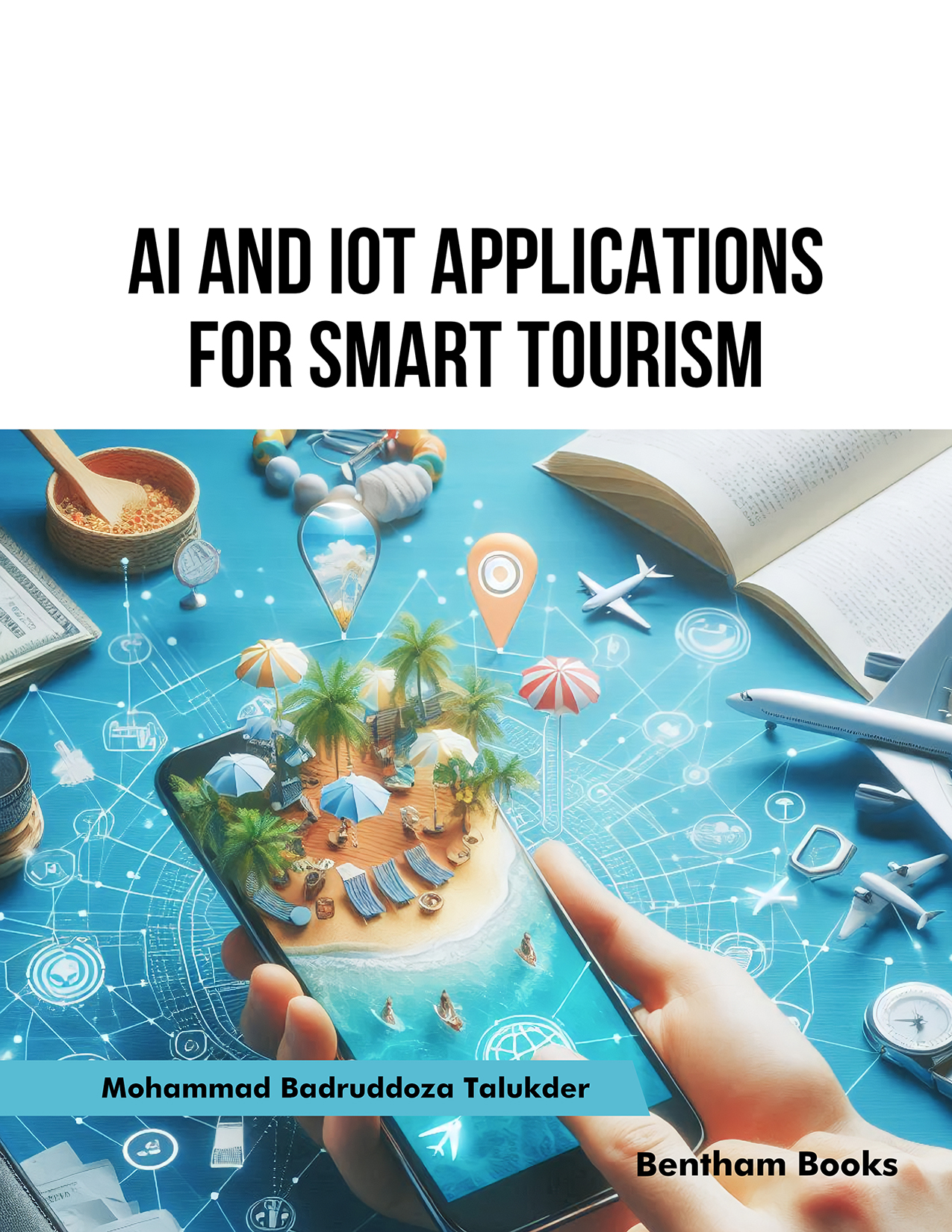
Author: Mohammad Badruddoza Talukder

Affiliation: College of Tourism and Hospitality Management, International University of Business Agriculture and Technology, Dhaka 1230, Bangladesh

AI and IoT Applications for Smart Tourism

eBook: US $79 Special Offer (PDF + Printed Copy): US $127
Printed Copy: US $87
Library License: US $316
ISBN: 979-8-89881-922-4 (Print)
ISBN: 979-8-89881-921-7 (Online)
Year of Publication: 2026
DOI: 10.2174/97988988192171260101

Introduction

AI and IoT Applications for Smart Tourism explores how artificial intelligence and the Internet of Things are reshaping tourism and hospitality through intelligent services, personalized experiences, and data-driven decision-making. Across ten chapters, it examines AI and IoT integration frameworks, smart marketing and customer engagement, overtourism management, IoT-enabled destinations and technology startups. The book also addresses robotics, immersive technologies, predictive analytics and smart governance, alongside data privacy, cybersecurity, ethical AI and sustainability. It offers valuable insights for developing smarter, more resilient, inclusive and sustainable tourism destinations.


Key Features

  • - Interdisciplinary perspectives on tourism and technology.
  • - International case studies and success stories.
  • - Conceptual frameworks with practical applications.
  • - Strategic recommendations for responsible technology adoption.

Target Readership :

Tourism and hospitality researchers, academics, postgraduate students, destination managers and tourism technology professionals; also policymakers, entrepreneurs, hospitality executives, digital strategists and technology developers.

Foreword

Tourism is undergoing one of the most revolutionary periods in its history. With the operational paradigms of destinations being endlessly redefined by artificial intelligence and the Internet of Things, the decision-making process of travelers and the experience of storytelling, the industry is on the brink of a new age. This age can be defined not only by technological innovation but also by intelligent empathy, sustainability, and human-focused design.

This book, titled AI and IoT Applications for Smart Tourism, arrives at the right time. Dr. Mohammad Badruddoza Talukder provides an insightful, future-oriented analysis of how emerging technologies are transforming tourism ecosystems. Clarity and intellectual rigor enable this work to bridge the fields of computer science, management, digital innovation, and hospitality, which explains why data-driven systems and interconnected devices can improve the organization's operations and travelers' well-being.

The book's value lies in its focus on integration, showing that AI and IoT do not operate independently but form a unified architecture that enables smart destinations, predictive services, sustainability goals, and more personalized visitor experiences. Dr. Talukder's interdisciplinary approach makes this volume a valuable tool for researchers, practitioners, policymakers, and students who want to understand or influence the development of tourism in the digital era.

In addition to outlining the possibilities of technology, the book offers a roadmap for responsible, ethical, and human-oriented use. Not only will readers have an enhanced knowledge base, but they will also gain a new perspective on the prospects of smart tourism innovation in relation to the potential liabilities associated with it.

It is my honor to contribute this valuable perspective to the international discussion on the future of tourism.

A.K. Haghi
Department of Chemistry
Institute of Molecular Sciences
University of Coimbra
Coimbra 3000-547, Beira Litoral
Portugal