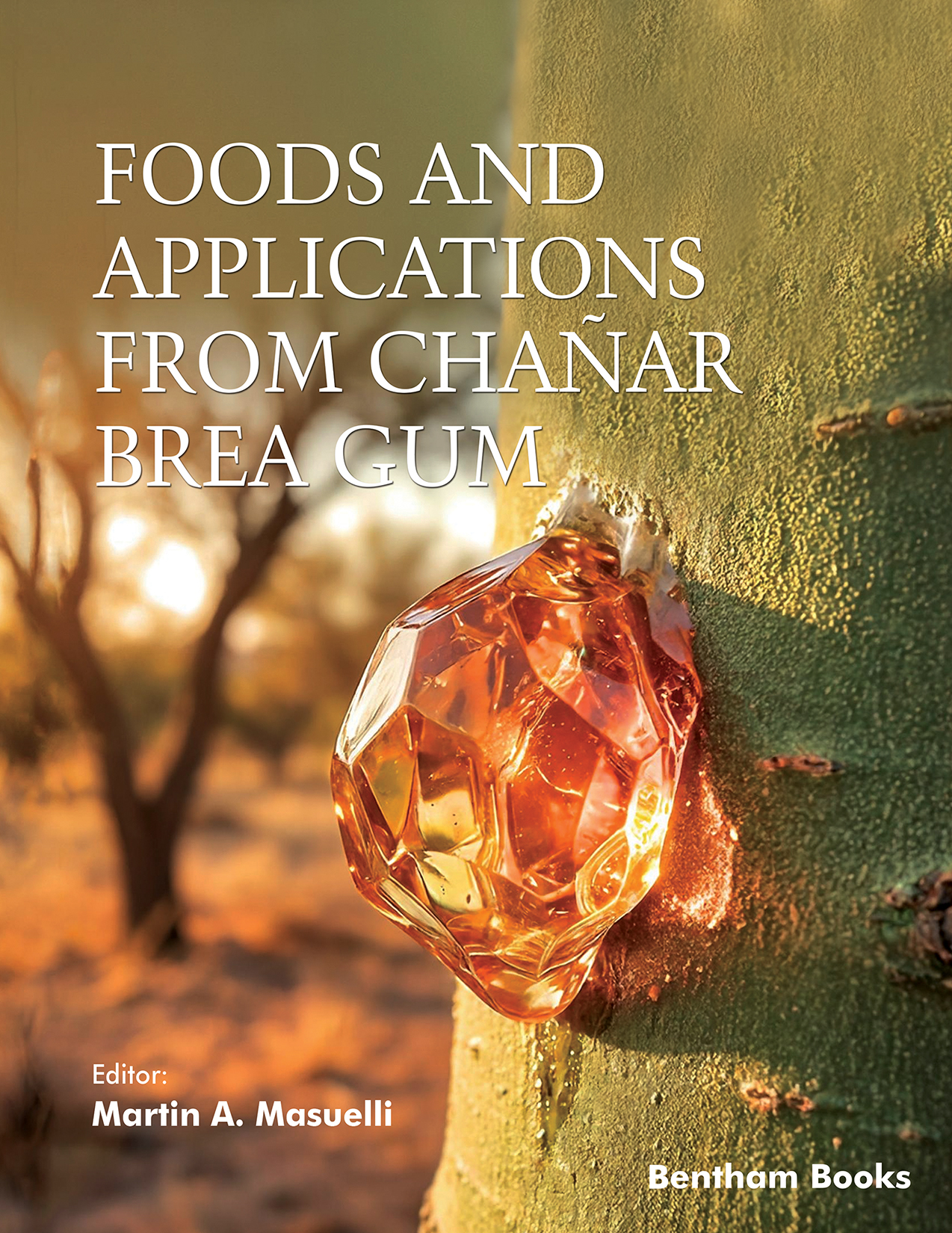
This e-book, "Foods and Applications from Chañar Brea Gum", represents a comprehensive compilation of cutting-edge research on this remarkable natural hydrocolloid. Edited by Martin A. Masuelli, this work is the result of the collaborative effort of distinguished researchers from various institutions in Argentina, who have contributed their knowledge to unravel the properties and applications of chañar brea gum. We extend our sincerest gratitude to all the authors for their invaluable contribution and dedication in the preparation of this volume. We would also like to thank Bentham Publishing and editors Humaira Hashmi and Aleeza Marium.
This book is aimed at a wide audience, including students, academics, scientists, and industrialists interested in the fields of biopolymers, food science, chemistry, and sustainability. It seeks to be a fundamental reference for those who wish to deepen their knowledge of Chañar Brea Gum (CBG) or Brea Gum (BG) from the Parkinsonia praecox tree (ex Cercidium praecox), explore its innovative applications, and contribute to the development of more sustainable solutions in various industries.
Throughout its chapters, the e-book covers everything from the fundamental aspects of chañar brea gum to its most recent and promising applications.
“State of Art of Chañar Brea Gum: From Botany to Industrial Applications”, authored by Maria Fernanda Torres, Mauricio Filippa, and Martin A. Masuelli, from INFAP-CONICET-UNSL. This text serves as a brief introduction to everything that is known about gum, its origins, sources, previous studies, applications, and the latest developments on this topic.
Chapter 1, "Differential impact of salinity and drought on germination of Parkinsonia praecox : Implications for its production areas", authored by Valeria Villarreal, Analía Llanes, and Laura Sosa, from the National University of San Luis and the National University of Río Cuarto, explores the resilience of Parkinsonia praecox under adverse environmental conditions. This chapter highlights the species' ability to establish itself in soils with high salt concentrations and water-deficient environments, which is crucial for understanding its distribution and its potential for the rehabilitation of degraded environments. Chañar brea gum, obtained from the exudate of this plant, is an economically competitive alternative in rural environments where it grows.
Chapter 2, "Structure of Chañar Brea Gum Polysaccharides", by Frank Sznaider, Ana M. Rojas, Carlos A. Stortz, and Diego A. Navarro, from the University of Buenos Aires, delves into the chemical composition of chañar brea gum. This chapter reveals that the purified polysaccharide fraction (BG) from the exudate is constituted by 75% carbohydrates, 17% uronic acids, a low proportion of proteins (≈ 9%), and 2.6% acetyl groups. The identification of monosaccharides such as xylose, arabinose, glucuronic acid, and 4-O-methylglucuronic acid in a molar ratio of 1:0.44:0.16:0.22, along with detailed structural analysis, provides a deep understanding of this highly substituted and acetylated arabinoglucuronoxylan with an average molecular weight of 122 kDa. This structural characterization is fundamental to understanding its functional properties.
Continuing with chemical and rheological properties,
Chapter 3, "Brea Gum Arabinoglucuronoxylans and their Chemical Derivatives as a Rheological Alternative to Gum Arabic", also authored by Frank Sznaider, Carlos A. Stortz, Ana M. Rojas, and Diego A. Navarro, from the University of Buenos Aires, compares the behavior of chañar brea gum with gum arabic. It highlights the pseudoplastic behavior of chañar brea gum and its higher initial thickening capacity compared to gum arabic. Furthermore, the importance of acetyl groups in the flow behavior of the gum is explored, and how amidation can modify its properties, opening new avenues for its commercial use.
Chapter 4, "Intrinsic Viscosity of Chañar Brea Gum", by Maria Fernanda Torres, Alba Benuzzi, Mauricio Filippa, and Martin A. Masuelli, from the Institute of Applied Physics-CONICET and the National University of San Luis, focuses on the precise determination of intrinsic viscosity, a fundamental property for understanding the rheological behavior of biopolymers. This chapter compares various graphical representation methods with the Huggins method, which is considered the standard for intrinsic viscosity in the study of biopolymers in solution, for calculating the intrinsic viscosity of chañar brea gum, which is crucial for its characterization and industrial application.
Chapter 5, The Solubility of Chañar Brea Gum as a Temperature Function, is the subject presented by Maria Fernanda Torres, Mauricio Filippa, and Martin A. Masuelli, from the same institutions. This study reveals that the intrinsic viscosity measurements in CBG solutions decrease with increasing temperature and that CBG exhibits a more rigid behavior below 25 °C, with its flexibility beginning to increase above this temperature. These findings are essential for understanding its behavior in both dilute and concentrated solutions, and its usefulness in food and pharmaceutical applications.
Chapter 6, "Gums Interaction with Chañar Brea Gum", by Romina Postemsky, Maria Fernanda Torres, Alba Benuzzi, Mauricio Filippa, and Martin A. Masuelli, explores the interactions of chañar brea gum with other hydrocolloids. A marked synergism between gum arabic (AS) and chañar brea gum (GB) is observed in diluted solutions, which has important implications for the development of food and pharmaceutical formulations where the combination of hydrocolloids can optimize functional properties.
In the field of food applications,
Chapter 7, "Application of Brea Gum (BG) in bakery: characteristics of white bread and bread with the addition of tarwi isolate (Lupinus mutabilis sweet), made with the addition of a regional hydrocolloid", authored by Estela Patricia López, from the National University of Salta, investigates the use of chañar brea gum as a retarding agent for the appearance of staling signs in bread. The results demonstrate that the incorporation of BG into the bread formulation allows for an improvement in the texture of the crumb at 48 and 72 hours of storage, due to its higher moisture content. It also increases the shelf life of the bread.
Following with food applications,
Chapter 8, "Development of Gluten-Free Cookies with Chañar Brea Gum", by Maria Fernanda Torres, Karen Gil Milac, Romina Postemsky, Dario Diaz, Guillermo Bianciotti, Mauricio Filippa, and Martin A. Masuelli, from the Institute of Applied Physics-CONICET and the National University of San Luis, explores the potential of chañar brea gum as a gluten substitute in bakery products. This chapter presents the formulation and evaluation of gluten-free cookies with the addition of chañar brea gum flour in increasing concentrations, highlighting its ability to modify the rheological properties and improve the quality of products for celiac patients.
Chapter 9, "Functional Potential of Brea Gum in Food Systems: Emulsifying, Thickening, and Stabilizing Properties", written by Marisol Nievas, Edgar M. Soteras, María M. Montenegro, Roberto Carrizo Flores, Gabriela Tobarez, Gabriela Alaniz, María E. Milani, Gabriela Achad, and Adrián Giurno, Liliana M. Grzona, from the National University of San Luis, offers a comprehensive review of the functional properties of chañar brea gum. This chapter highlights its approval by the Argentine Food Code as a thickening, stabilizing, and emulsifying agent, and its capabilities in stabilizing emulsions, clarifying beverages, and modifying the texture of products such as sauces and soups. Chañar brea gum is presented as a natural and innovative alternative for the development of functional products.
Chapter 10, "Applications of Chañar Brea Gum in the Formulations of Gluten-Free Breads, Salad Dressing and Balanced Animal Feed", by Ana N. Rinaldoni, Diana R. Palatnik, María V. Ostermann Porcel, Gabriel E. Castro, Ulises A. Gonzalez, and Mercedes E. Campderrós, from the National University of San Luis, delves into various applications of chañar brea gum. It demonstrates its ability to improve the specific volume and texture of gluten-free breads, showing reduced hardness, springiness, and gumminess when compared to control samples, and its role as a thickener and stabilizer in vegetarian dressings. Furthermore, its use in balanced animal feed is explored, where it contributes to pellet consistency and a higher protein efficiency ratio.
Chapter 11, "Films of Brea Gum: Edible Coatings and Microencapsulation Systems", by María A. Bertuzzi and Aníbal M. Slavutsky, from the Institute of Chemical Industry Research (INIQUI-CONICET), addresses the use of chañar brea gum in the development of biodegradable materials for food packaging and encapsulation. This chapter highlights its potential to replace synthetic polymers, its application in spray-dried microencapsulation for protecting sensitive compounds, and the formulation of edible films with improved mechanical and barrier properties. These insights underscore BG's promise in developing sustainable food packaging and pharmaceutical delivery systems.
Chapter 12, "Chañar Brea Gum and Its Application in Drug Co-Solubility. Case of Chlorphenamine Maleate", by Maria Fernanda Torres, Mauricio Filippa, and Martin A. Masuelli, from the Institute of Applied Physics-CONICET and the National University of San Luis, delves into the pharmaceutical field. This chapter studies the interaction between chañar brea gum and chlorphenamine maleate (CIF) by evaluating chain flexibility, chemical potential, and preferential interaction parameters with respect to temperature. The findings suggest an increased affinity for water molecules with rising temperature, enhanced by CIF addition, which could have implications in drug formulation.
Collectively, this e-book underscores the vast potential of chañar brea gum as a versatile and sustainable biopolymer. The research presented here not only expands scientific knowledge about its fundamental properties but also opens up a range of possibilities for its application in various industries, from food and pharmaceuticals to advanced materials. We hope that this work will inspire new research and foster the utilization of this valuable natural resource in the pursuit of more innovative and environmentally friendly solutions.
Martin A. Masuelli
Instituto de Física Aplicada-CONICET
Universidad Nacional de San Luis
San Luis, Argentina
&
Departamento de Química, Facultad de Química
Bioquímica y Farmacia, Universidad Nacional de San Luis
San Luis, Argentina