
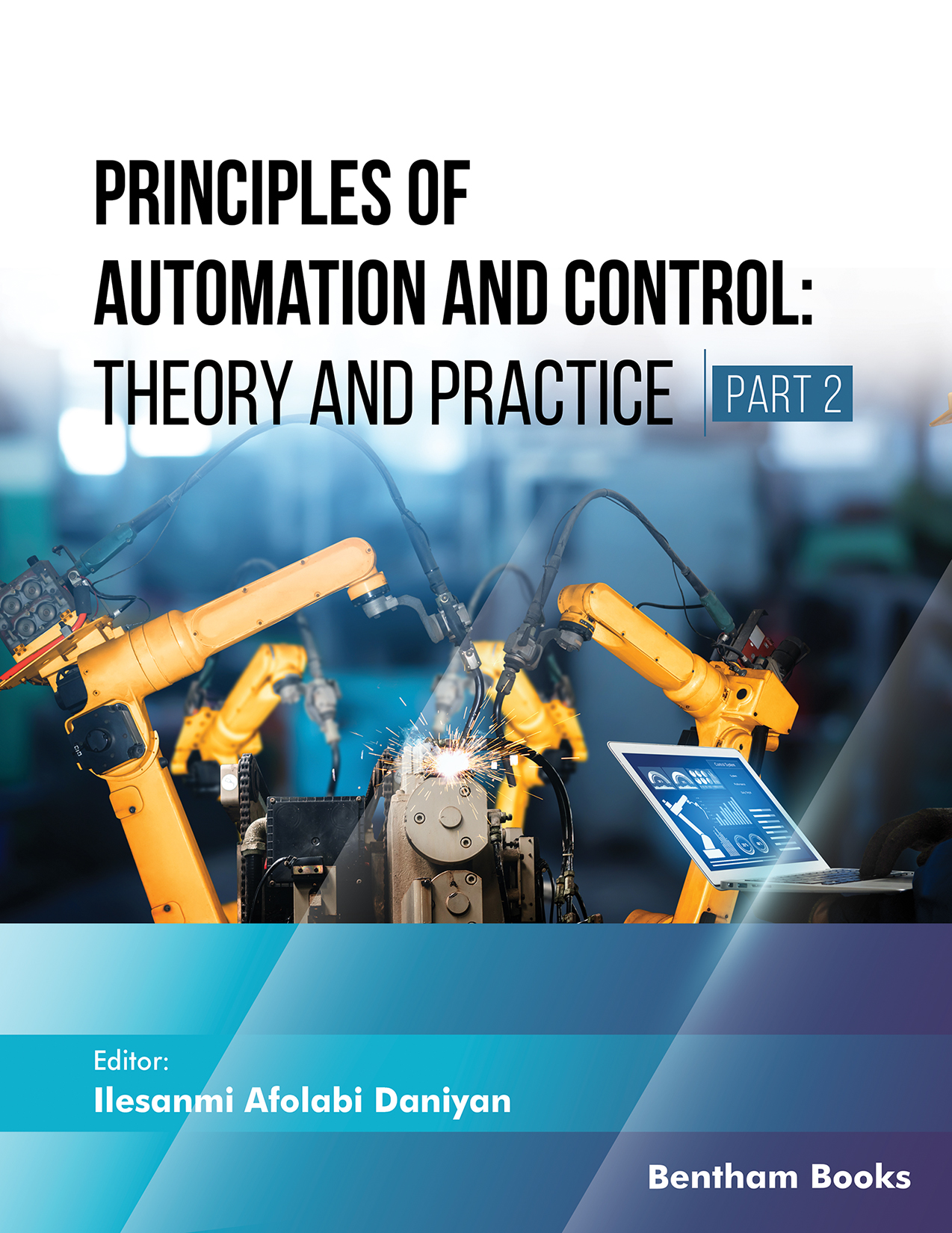
Principles of Automation and Control: Theory and Practice (Part 2)

Editor: Ilesanmi Afolabi Daniyan

Principles of Automation and Control: Theory and Practice (Part 2)

ISBN: 979-8-89881-619-3
eISBN: 979-8-89881-618-6 (Online)

Introduction

Principles of Automation and Control: Theory and Practice is a practical textbook that introduces the fundamental concepts and modern applications of automation and control systems. Designed for students, researchers and engineering professionals, it explains the technologies and control strategies that support efficient, reliable and sustainable industrial operations. With a focus on Industry 4.0, the book combines theoretical foundations with practical examples to illustrate the role of automation in contemporary engineering.

Part 2 explores IoT-enabled energy management systems, machine learning for clinical diagnosis and predictive maintenance, voice-controlled robotics and unmanned aerial vehicle control. It also examines intelligent manufacturing frameworks, responsible AI in healthcare, adaptive fuzzy logic controllers for energy optimization, AI applications in precision agriculture and modern motor control technologies. Additional chapters review smart switchgear, motor control systems and advanced feedback mechanisms, illustrating how intelligent automation is transforming manufacturing, healthcare, agriculture and industrial control.


Key Features

  • - Explains advanced automation and intelligent control technologies.
  • - Covers IoT, artificial intelligence and machine learning applications.
  • - Examines automation in healthcare, manufacturing, agriculture and robotics.
  • - Reviews modern motor control systems and feedback mechanisms.
  • - Combines theoretical concepts with practical engineering applications.
  • - Structured chapters for easy learning.
  • - References for further reading.

Target Readership:

Engineering students at graduate and post graduate levels; Automation engineers.

Preface

The field of automation and control increasingly gaining increasing traction as industries move toward improved efficiency, precision, and autonomy. Thus, there is a need to understand the governing principles and the enabling technologies such as computing, communication technologies, Artificial Intelligence (AI), smart sensor and Internet of Things (IoT).

This book, Principles of Automation and Control II, discusses the foundational and fundamental concepts of automation and control. It combines both the theoretical background with practical applications to bridge the gap between theory and practice. This book is intended primarily for engineering students at all levels of study and related disciplines, as well as experts and professionals seeking to broaden their knowledge in this area. The book is organized to promote a seamless flow of thoughts and to progressively guide the readers from the basic concepts to more advanced topics. The Part 1 had laid the foundation on the basic and theoretical principles while this part 2 (chapter 14-25) details on the development of control systems, system modelling techniques and analysis methods, application of AI techniques in automation and control including practical examples. Practical examples include application of IoT and AI for sustainable energy management, in healthcare for prognostics and diagnostics operation, manufacturing system such as prediction of machine failure and for enabling manufacturing resilience, in the deployment of Unmanned Aerial Vehicle (UAV), in environment and agriculture for smart irrigation and in mechanical systems for switch gear and motor control. Wherever possible, theoretical discussions are complemented with examples and applications to enhance reader’s understanding.

To promote clarity, mathematical rigour is maintained where necessary, and supported with conceptual understanding and empirical findings. The book also highlights emerging trends, such as AI and data-driven control approaches, to reflect the dynamics of modern engineering.

The journey written to support readers in their journey from theory to application. It will help readers gain useful insights necessary for the development monitoring, control and analysis of industrial systems in real-world settings.

Ilesanmi Afolabi Daniyan (Editor)
Department of Mechatronics Engineering
Bells University of Technology, P. M. B. 1015
Ota, Ogun State, Nigeria